
Have you ever thrown a rock into a still pool of water and watched the ripples expand?
No matter the size of the stone, the impact spreads in widening circles.
The same is true in international development and eye health care.
How the ripple effect shaped our work in 2025
Every gift of sight creates ripples that transform lives. For girls and boys, women and men, restored sight opens doors to education, employment and independence. Those benefits don’t stop there – they carry on, extending through families, communities and even the global economy: Vision loss costs an estimated US $411 billion in lost productivity each year, according to a 2021 article in The Lancelet Global Health Journal.
In 2025, your support meant everything. It was a year when the “pool of water” was anything but still. Yet our global community came together. Your collective generosity created nothing short of seismic waves of impact across 10 countries.
Every year, your support empowers our teams and partners to screen millions of people, provide hundreds of thousands of those with vision loss with prescription eyeglasses and perform hundreds of thousands of cataract surgeries (2025 data and details will be shared in our 2025 annual report).
Thank you for standing in solidarity with us, with communities, and with our teams and partners around the world – For All the World to See!
2025 Highlights
Here are some of our 2025 milestones and accomplishments that were achieved thanks to your support.
Global
Impact recognition
For the eighth consecutive year, Operation Eyesight was named a Top 10 Impact Charity by Charity Intelligence Canada.
Growing global reach
We doubled traffic to our global website, raising awareness about the importance of eye health and how it impacts lives, communities and countries.
Cataract surgery success
With your support, we raised $410,000 CAD for our nine-country cataract surgery initiative, surpassing our $405,000 goal. This will fund an additional 5,400 cataract surgeries, some of which are already underway. For each country, this means the following additional cataract surgeries:
- 400 in each of Bangladesh, Ethiopia, Liberia, Malawi and Nepal
- 1,000 in Ghana
- 900 in India
- 800 in Kenya
- 700 in Zambia
Why it matters: Cataracts are the leading cause of blindness worldwide. One surgery, including supports such as travel, costs approximately $75 CAD. Cataract surgery is one of the most cost-effective health interventions, according to the IAPB Vision Atlas.
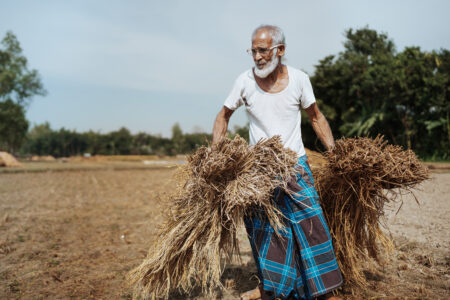
Saidur’s story shows how cataract surgery changes lives. At 70, Saidur, from Bangladesh, was nearly blind and unable to work. After cataract surgery, he said, “I am very happy to be able to see my grandchildren. I can finally earn a living again.” Watch his ripple effect story.
Africa
Ethiopia
A World Sight Day school eye health initiative led to the screening of 1,200 students in Bahir Dar City. Students in need also received free prescription eyeglasses.
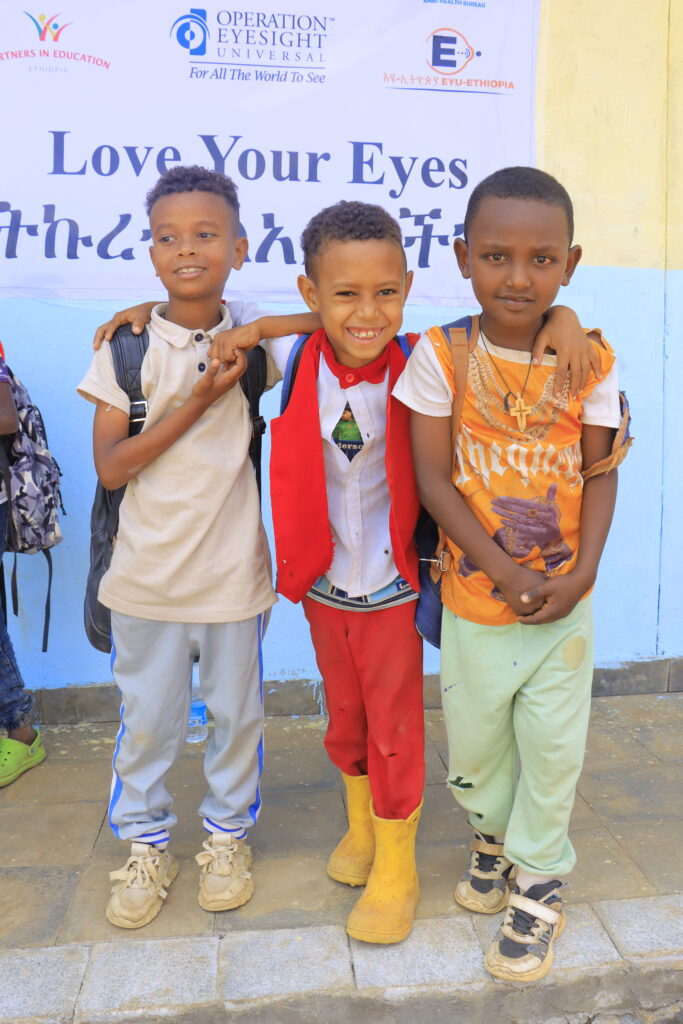
Amanuel, Bereket and Amen pose after getting their eyes screened at school leading up to World Sight Day.
Ghana
We expanded our School Eye Health Program to Shai Osu Doku district. Program Coordinator Isaac Baffoe has been working closely with schools to reach even more children. See how the program works and how it helps students access quality education.
Kenya
With new funding from Johnson & Johnson, we launched our Hospital-Based Community Eye Health Model in four underserved counties. Tens of thousands of people have already participated in door-to-door screenings, and more than 2,000 cataract surgeries will be performed. See how this project brings eye health care closer to home in rural areas.
Malawi
We opened our first vision centre in Malawi, greatly reducing travel for patients and improving access to care.
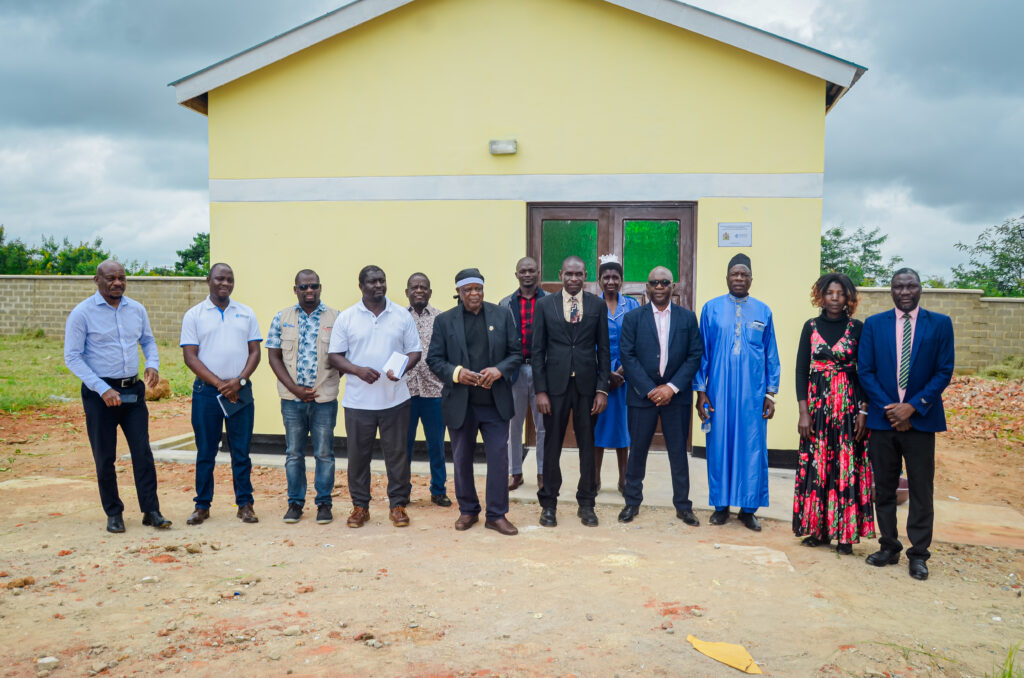
Our Malawi team and partners attend the opening of the new vision centre, which will serve more than 256,000 people.
Zambia
We rehabilitated 72 boreholes, exceeding our target of 69 and improving access to clean water for more than 50,000 people.
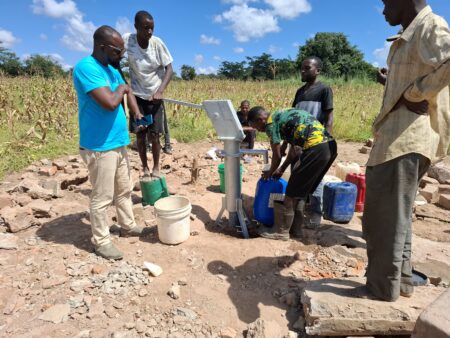
Community members gather water at a borehole in Zambia.
North America
Canada
- In April, we partnered with the Maskwacîs Education Schools Commission and the OneSight EssilorLuxottica Foundation to deliver a weeklong vision care clinic. More than 400 students received eye exams, and many received prescription eyeglasses.
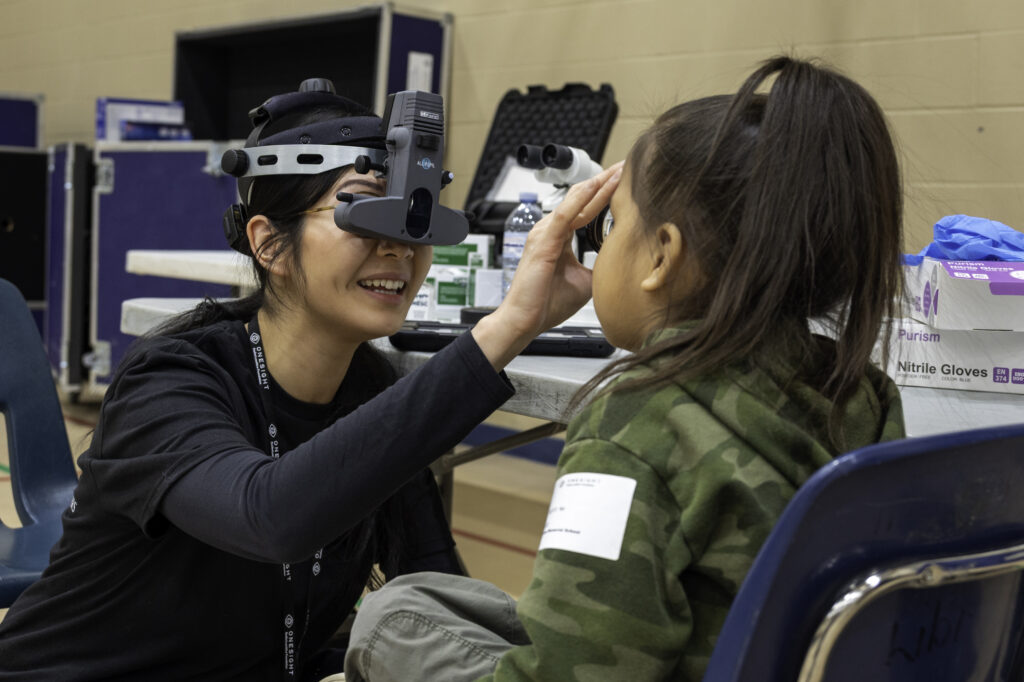
Caption: A child has his eyes screened during a weeklong vision care clinic conducted in partnership with Maskwacîs Education Schools Commission and the OneSight EssilorLuxottica Foundation.
In June, we participated in the Rotary International Convention in Calgary. Since the early 1980s, 474 Rotary clubs have contributed $3.88 million, not including direct grants to our partners. Since 2020, 23 clubs have made more than 3,100 gifts, totaling $748,565.
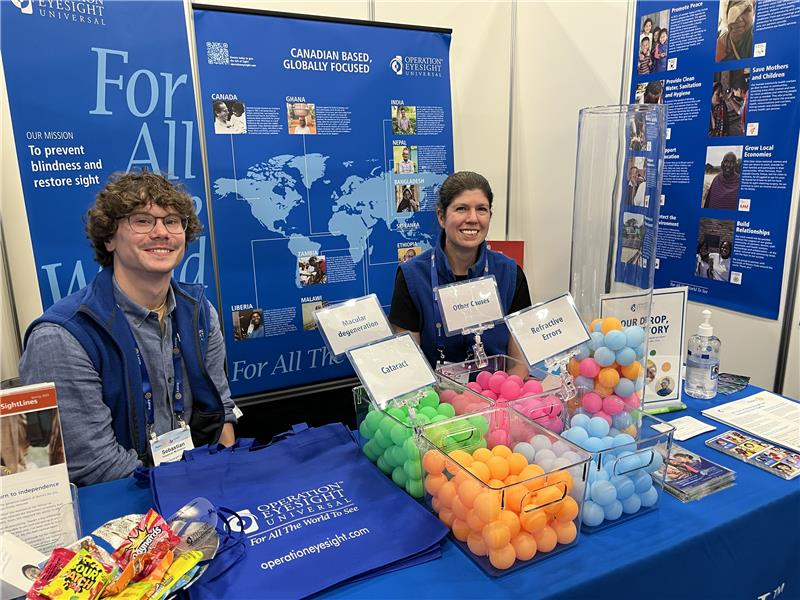
Members of our team connected with hundreds of Rotary club members and attendees at the Rotary International Convention in Calgary in June.
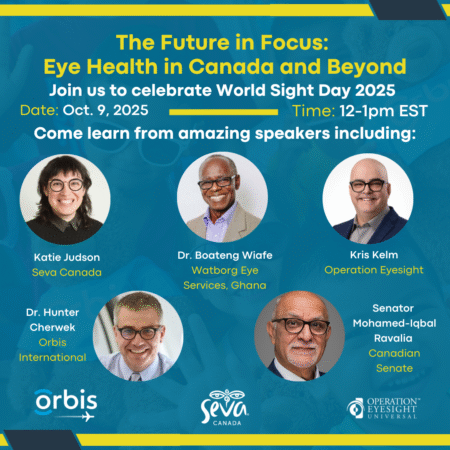
On World Sight Day, October 9, Kris Kelm, our Global Director, International Programs and Chair of the Canadian Eye Health Coalition, hosted a global webinar, and landmarks across Canada lit up in our brand colours to raise awareness.
The Calgary Tower (see below) lit up in orange and blue, our brand colours, for World Sight Day to raise awareness of the importance of eye health care. The CN Tower, Guelph Market Square and Winnipeg Esplanade Riel Bridge also displayed our colours.

This fall, we celebrated Diwali, the Hindu festival of lights, at events in Calgary and Toronto, and another in London, United Kingdom, strengthening connections with Indian diaspora communities and expanding support for our work in South Asia and around the world.
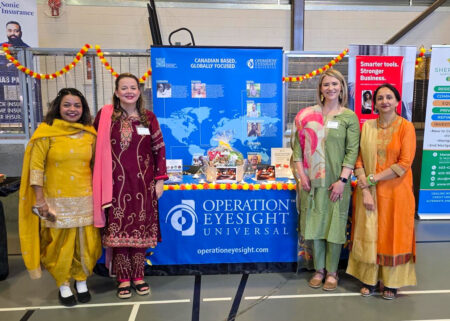
Members of our Canada team attend a Diwali event in Calgary.
In the week leading up to Giving Tuesday, December 2, through the collective support of donors, we surpassed our original target of $35,000 and raised $63,166.61 thanks to the dollar-for-dollar matching funds ($45,000) from our anonymous donors! This resulted in a total of $108,266.61raisied to support additional cataract surgeries.
South Asia
Bangladesh
Leading up to World Sight Day, our partners screened 1,719 people, including 1,627 schoolchildren at 11 schools. A total of 183 people received free prescription eyeglasses.
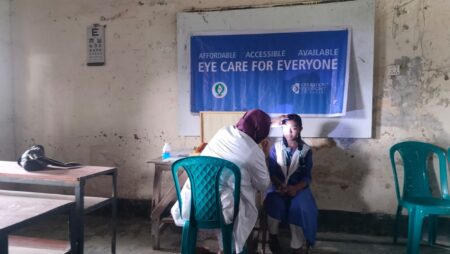
A student has her eyes examined during a school eye heath screening in Bangladesh.
India
We renewed our partnership with the National Health Mission, Government of Madhya Pradesh, to strengthen eye health services across 10 districts. This marked a significant step in strengthening people-centred eye health systems across the state.
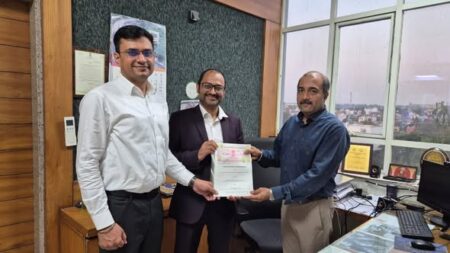
Anchored in the World Health Organization’s Integrated People-Centred Eye Care (IPEC) framework, the initiative delivers sustainable, community-focused eye care fully integrated into the public health system. Currently, we’re implementing IPEC interventions across 17 districts in Arunachal Pradesh, Madhya Pradesh and Meghalaya, in partnership with the state Ministries of Health. This work restores more than sight – it restores dignity, independence and livelihoods for entire communities.
Nepal
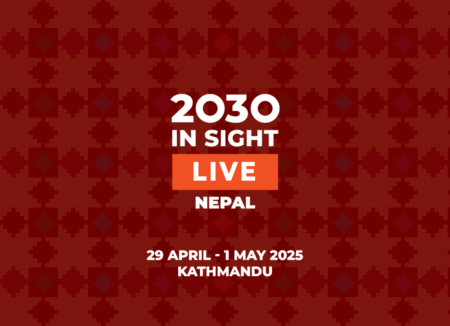
Our President and CEO Kashinath Bhoosnurmath attended the IAPB LIVE In Sight conference in Kathmandu, bringing together global leaders and policy-makers to advance universal eye health.
Thank you for your support. Full 2025 details and data will be shared in our 2025 Annual Report.